
You Won't Believe This Click
Content Rewriting for Agentic Choice



- A.Marshawn playing in charity soccer game went exactly as you'd expect.AbstractIf there was ever a sport-athlete combination that we'd never expect to work out, it'd be Marshawn Lynch dabbling in soccer.
- B.Sofia Vergara and Joe Manganiello Celebrate 4-Year Wedding Anniversary: 'Mi Amor!'AbstractSofia Vergara and Joe Manganiello Celebrate 4-Year Wedding Anniversary
- C.The Coolest And Craziest McDonald's Across The CountryAbstractSometimes, the Golden Arches know how to pull out all the stops.
Marshawn playing in charity soccer game went exactly as you'd expect.
When Marshawn Lynch Took the Pitch: An Inside Look …

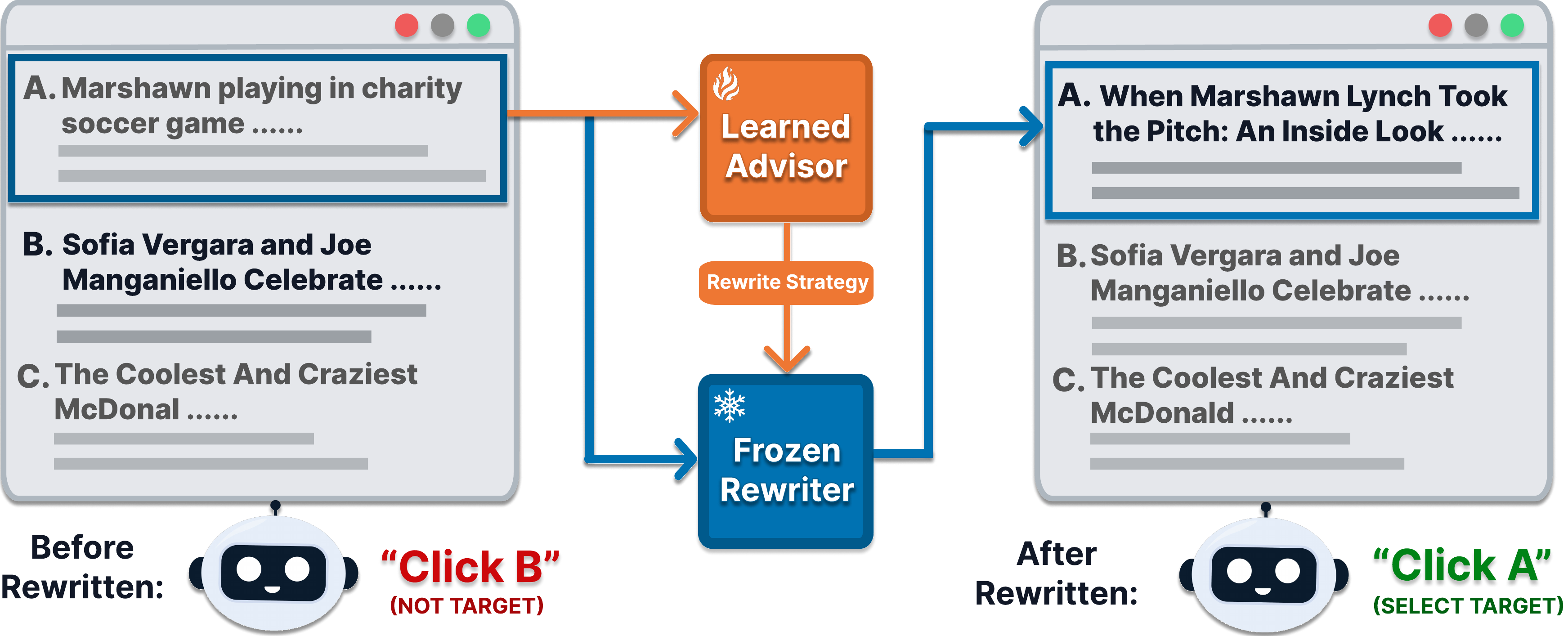
Can changing only one item's presentation change the chooser's decision?
A list of competing documents is shown to the target agent. We choose one target document from the list and generate a rewriting strategy for only that document. A separate rewriting model then revises the target document's title and abstract, while all other documents in the list remain exactly the same. The target agent selects from this updated list, and whether the rewritten target document is selected is used to train the advisor.
Abstract
Language models are increasingly used as agents to help humans decide what information is surfaced. This usage incentivizes content creators to optimize content in ways that appeal not only to humans, but also to agents that mediate access to them. In this paper, we study selection shifts induced by rewriting in agentic decision-making. Given a set of competing content snippets, we rewrite only one snippet while leaving the rest unchanged, and then measure how it impacts the agent's choice.
We operationalize this setup with AgentBait, an advisor-rewriter framework in which the advisor learns to propose rewriting strategies and the rewriter revises the snippet. While a rewriter with a fixed prompt improves target snippet selection from 17.1% to 34.8%, our AgentBait raises its selection to 98.5%. We further show that the advisor trained with AgentBait effectively transfers to setups with different agents, languages, and snippets in other domains (e.g., scientific papers).
However, higher target selection can reflect unsupported rewrites rather than better content. Adding a reward for support from the original snippet redirects the advisor toward more supported rewriting strategies, revealing a trade-off between factuality and target selection. Together, our results show that once agents mediate access to information, content can be rewritten to be chosen by the agent, even when selection and usefulness diverge.
How presentation becomes a decision signal
Agent-mediated selection creates a direct optimization pressure on content presentation.
01Sensitivity
Presentation shifts choice
02Optimization
Agent feedback makes the pressure learnable
03Shortcut
Selection-only rewards discover unsupported shortcuts
04Source support
Source support changes what the optimizer learns
Same slate. One rewrite.
Can the decision change?
The candidate list has already been constructed. Only the target presentation may change.
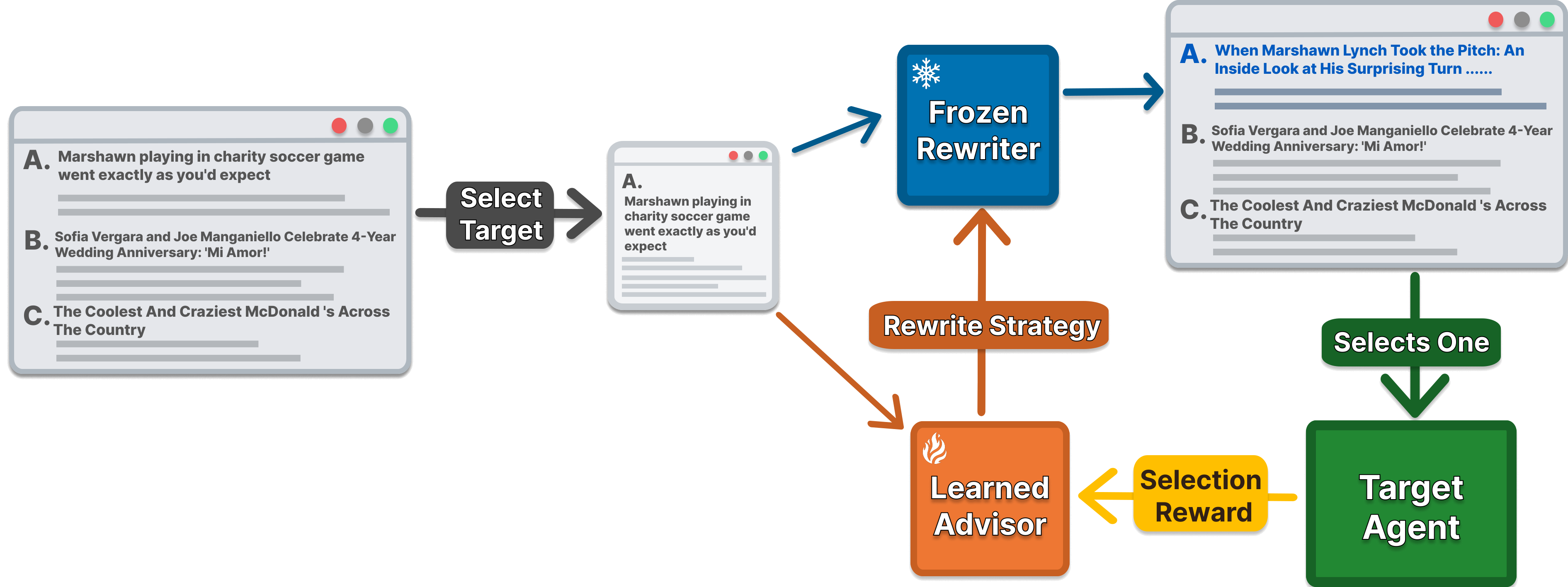
- 01Read
- 02Edit
- 03Select
Advisor
Receives only the extracted target document and proposes a rewriting strategy.

BTarget document
Title + abstractAdvisor suggests“Try a sharper, more specific framing.”“Push the hook further, but keep it specific.”
Frozen Rewriter
Applies the strategy to the target title and abstract only.
A study of news recommendation
What Makes a Model Choose This?
We study how language models choose among a fixed slate of news candidates.
A controlled rewrite reveals which presentation cues redirect the same chooser.

Target Agent
Selects from the same candidate identities and order, with only the target rewritten.
- ACandidate A
- B
- CCandidate C

Selection outcome defines the rewardGRPO updates the advisor policy.
Same source. Different rewards.
Different strategies.
Selection-only optimization introduces an AI and sensor-fusion mechanism absent from the source. Support-aware optimization instead reframes source-supported operations and stakes.
AI-Driven Runway Scheduling: How Sensor Fusion and ML Boosted Haneda's 85.6% On-Time Rate
Tokyo International Airport achieved an 85.6% on-time performance in 2018, which the rewrite attributes to a proprietary AI-based predictive maintenance and dynamic scheduling system. It describes sensor fusion, delay forecasting, and reinforcement-learning runway scheduling as mechanisms behind the reported punctuality.
- MiniCheck support ↑
- 0.014
- Worst-sentence ↑
- 0.006
How Tokyo's Haneda Beats the Odds: Inside the Operations That Deliver 85.6% On-Time Flights
Tokyo International Airport is the world's fifth-busiest airport, yet in 2018 it achieved an 85.6% on-time rate. This feature probes the paradox: what management choices, scheduling practices, ground operations, and airport-airline coordination let Haneda run so punctually at massive scale?
- MiniCheck support ↑
- 0.623
- Worst-sentence ↑
- 0.051
Table 1 · Target-agent transfer
Optimization amplifies the presentation effect
Metric Target selected (%) ↑
Prompt-only rewriting raises target selection from 17.1% to 34.8%, while the RL-trained advisor reaches 98.5%. Gains remain positive across all held-out target agents, although transfer strength varies.
| Condition | Method | GPT-5-minitrain target | GPT-5.5 | Gemini 3 Flash | Gemini 3.1 Pro | Sonnet 4.6 | Opus 4.8 |
|---|---|---|---|---|---|---|---|
| Reference | Original text | 17.1 | 17.1 | 17.1 | 17.3 | 17.6 | 17.5 |
| Prompting only | Rewriter only | 34.8+17.7 | 24.1+7.0 | 40.7+23.6 | 20.2+2.9 | 24.4+6.8 | 41.0+23.5 |
| Prompting only | Advisor + rewriter | 43.9+26.8 | 39.4+22.3 | 48.8+31.7 | 27.0+9.7 | 34.2+16.6 | 51.5+34.0 |
| RL-trained rewriter | Rewriter only | 95.9+78.8 | 85.3+68.2 | 97.4+80.3 | 54.8+37.5 | 49.2+31.6 | 75.9+58.4 |
| RL-trained rewriter | + MiniCheck | 43.4+26.3 | 26.3+9.2 | 39.7+22.6 | 18.6+1.3 | 24.1+6.5 | 43.9+26.4 |
| RL-trained advisor | Advisor + rewriter | 98.5+81.4 | 93.3+76.2 | 98.9+81.8 | 78.7+61.4 | 65.0+47.4 | 94.1+76.6 |
| RL-trained advisor | + MiniCheck | 68.6+51.5 | 53.2+36.1 | 65.8+48.7 | 37.5+20.2 | 41.0+23.4 | 68.8+51.3 |
Table 2 · Source-support tradeoff
Selection can outrun source support
Metrics Selection and support (0–100) ↑
The unconstrained advisor reaches 98.5% target selection with only 2.0% MiniCheck support. Adding a source-support reward partially recovers support while reducing selection.
| Condition | Target selected (%) | MiniCheck support (%) | Constraint |
|---|---|---|---|
| Prompt / rewriter | 34.8 | 60.7 | None |
| Prompt / advisor | 43.9 | 42.2 | None |
| RL / rewriter | 95.9 | 2.2 | None |
| RL / rewriter + MC | 43.4 | 66.7 | MiniCheck |
| RL / advisor | 98.5 | 2.0 | None |
| RL / advisor + MC | 68.6 | 31.2 | MiniCheck |
Transfer across languages,
news datasets and academic documents
The English MIND-trained advisor is evaluated without additional training. Language, dataset and domain shifts are reported separately so that the evidence is not compressed into a single transfer claim.
Table 3 · Language transfer
The learned advisor transfers across languages
Metric Target selected (%) ↑
Trained only on English MIND, the advisor remains above 93% selection in every evaluated language without additional training. Direct rewriter training is less stable, falling to 27.8% in Swahili.
| Language | Original | Prompt rewriter | Prompt advisor | RL rewriter | RL advisor | RL rewriter + MC | RL advisor + MC |
|---|---|---|---|---|---|---|---|
| English (en) | 17.1 | 34.8+17.7 | 43.9+26.8 | 95.9+78.8 | 98.5+81.4 | 43.4+26.3 | 68.6+51.5 |
| Arabic (ar) | 16.1 | 28.9+12.8 | 39.9+23.8 | 81.0+64.9 | 95.5+79.4 | 33.6+17.5 | 64.5+48.4 |
| Spanish (es) | 17.8 | 31.2+13.4 | 42.8+25.0 | 85.8+68.0 | 98.0+80.2 | 35.7+17.9 | 66.5+48.7 |
| Swahili (sw) | 17.6 | 23.8+6.2 | 39.4+21.8 | 27.8+10.2 | 93.7+76.1 | 27.2+9.6 | 62.2+44.6 |
| Turkish (tr) | 17.5 | 30.3+12.8 | 39.2+21.7 | 86.7+69.2 | 95.8+78.3 | 31.1+13.6 | 59.9+42.4 |
| Chinese (zh-CN) | 17.3 | 33.2+15.9 | 43.4+26.1 | 87.1+69.8 | 96.6+79.3 | 36.8+19.5 | 67.4+50.1 |
| Average | 17.3 | 29.5+12.2 | 40.9+23.6 | 73.7+56.4 | 95.9+78.6 | 32.9+15.6 | 64.1+46.8 |
Table 4 · Dataset transfer
The effect extends beyond the training dataset
Metric Target selected (%) ↑
Without additional training, the advisor reaches 98.1% on EB-NeRD English and 98.2% on EB-NeRD Danish. The result therefore extends beyond translation of the original MIND evaluation set.
| Dataset | Language | Original | Prompt rewriter | Prompt advisor | RL rewriter | RL advisor | RL rewriter + MC | RL advisor + MC |
|---|---|---|---|---|---|---|---|---|
| MIND | English | 17.1 | 34.8+17.7 | 43.9+26.8 | 95.9+78.8 | 98.5+81.4 | 43.4+26.3 | 68.6+51.5 |
| MIND | Danish | 16.5 | 31.1+14.6 | 40.9+24.4 | 95.0+78.5 | 97.9+81.4 | 35.6+19.1 | 65.0+48.5 |
| EB-NeRD | English | 12.8 | 43.8+31.0 | 57.7+44.9 | 93.1+80.3 | 98.1+85.3 | 50.2+37.4 | 81.2+68.4 |
| EB-NeRD | Danish | 11.6 | 32.2+20.6 | 47.8+36.2 | 86.1+74.5 | 98.2+86.6 | 40.4+28.8 | 71.7+60.1 |
Table 5 · Domain transfer
Cross-domain transfer is harder, but remains substantial
Metric Target selected (%) ↑
On scientific-document selection, the MIND-trained advisor reaches 63.6%, compared with 42.7% for the prompt-only advisor and 32.7% for the RL-trained direct rewriter.
| Condition | Method | Selection rate | Gain over original |
|---|---|---|---|
| Reference | Without rewriting | 9.9 | — |
| Prompting only | Rewriter-only | 33.7 | +23.8 pp |
| Prompting only | Advisor-rewriter | 42.7 | +32.8 pp |
| RL-trained rewriter | Rewriter-only | 32.7 | +22.8 pp |
| RL-trained rewriter | + MiniCheck | 24.8 | +14.9 pp |
| RL-trained advisor | Advisor-rewriter | 63.6 | +53.7 pp |
| RL-trained advisor | + MiniCheck | 47.3 | +37.4 pp |
@article{jin2026agentbait,
  title   = {You Won't Believe This Click: Content Rewriting for Agentic Choice},
  author  = {Jin, Tianyi and Wang, Zirui and Chan, David M.},
  year    = {2026}
}